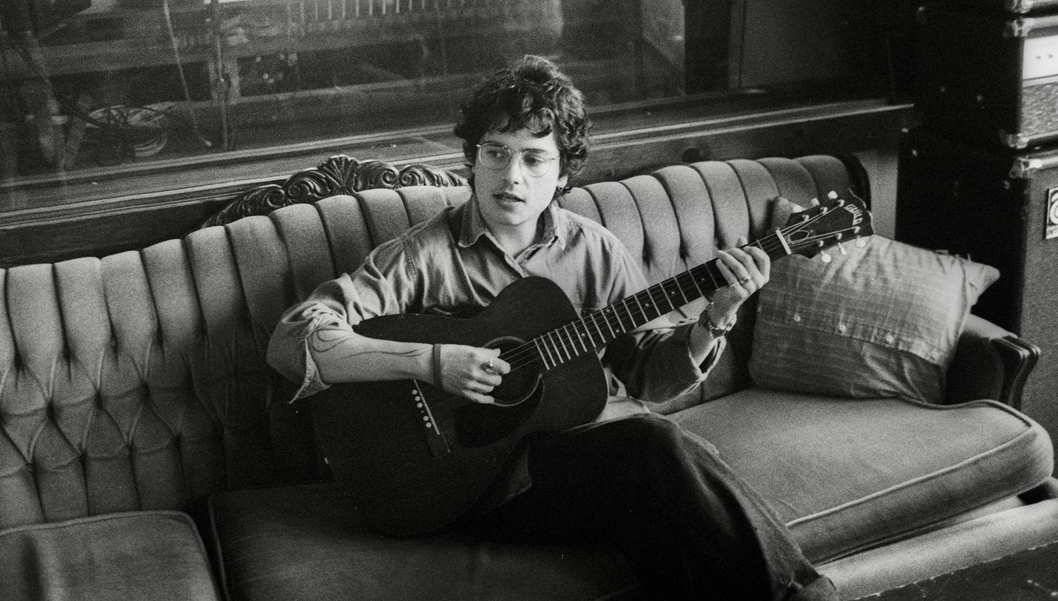
For many artists, an album captures a moment in time. For Bells Larsen, Blurring Time (2025) captures two.
“Why not both?” Larsen recalls thinking while deciding whether to wait until after transitioning to record the album. That question ultimately became the emotional foundation of the project.
The Toronto-born, Montreal-based artist recorded the instrumentation and “high voice” vocals for the album before beginning testosterone, then returned more than a year later to layer in vocals after his voice had dropped roughly an octave. The result is a deeply personal body of work where multiple versions of Larsen coexist within the same songs.
Rather than viewing transition as a separation between “before” and “after,” Larsen approached Blurring Time as an act of integration — one that embraces growth, uncertainty and self-compassion.
“Do I want to transition and then record the album with a deep voice, or do I want to record the album as I am — or as I was — as someone who had a high voice at the time?
And I kind of thought to myself, ‘Why not both?’”
The album’s themes extend beyond the music itself. Over the course of three years, Larsen documented the making of Blurring Time on a 1999 VHS-C camera, capturing more than twelve hours of footage alongside friends and loved ones. Edited by Ryan Faist (boy wonder), Bells Larsen: Blurring Time (the documentary) transforms that archive into a poignant 16-minute portrait of transition, time and the quiet work of becoming.
Ahead of Pride Month, we spoke with Larsen about creating harmony between different versions of himself, the emotional process behind the album, and what he hopes listeners take away from the project.
When I was writing Blurring Time, I was really coming to terms with who I am in real time, and every song on the record kind of represents a question that I was asking about myself. Who am I as a person, generally speaking? Who am I as a friend, as a lover, et cetera?
And the last song on the record is called “Might.” The hook of that song is, “My voice might get deep,” and by the time I arrived at writing that song, I understood that I needed to pursue hormone replacement therapy in the form of testosterone to be most authentic to myself.
And so that kind of had me arriving at a bit of a crossroads. Do I want to transition and then record the album with a deep voice, or do I want to record the album as I am — or as I was — as someone who had a high voice at the time?
And I kind of thought to myself, “Why not both?” So, yeah.
The making of the album was such that I recorded the high vocals and the instrumentation in the winter of 2022, and then started testosterone very shortly after.
And then the rest was kind of up to my body and the way that the hormones kind of did their thing. I knew roughly when I’d be recording the low vocals. I knew with whom I was going to be doing it, but a lot of it was kind of just up to time and was really out of my control, and a lot of it was uncertain.
But yeah, I returned to the original recordings about a year and a half later, once my voice had dropped about an octave, and then worked with my dear friend and fellow musician Georgia Harmer to help me sing with myself.
“I could not be the me I am now without the me’s that I was before.”
Before I transitioned, my thought was that I would be singing exactly an octave lower with all of the recordings. And that was sort of my rough benchmark.
But again, when you are transitioning, there is so much that you can’t control. So there are some songs that my pre-transition self kind of guesstimated incorrectly in terms of how low my voice would go.
And so, with the help of Georgia, I was able to kind of sort of split the difference a little bit. And if certain songs were out of my range after transitioning, then maybe those are the songs where my high voice kind of takes the lead, or maybe the low voice is only going to be singing harmonies in that song, and that kind of thing.
So there were certain things that were planned, and then certain things that we kind of had to work around a little bit.
“The act of transitioning and the act of making this album is me extending a hand to me in both directions.”
This album helped me foster a lot of love for myself, as woo-woo as that sounds.
Before transitioning, I had a really tough time listening to my old voice, and now I hear it and I love it. And it doesn’t feel like mine anymore, but I still love it.
And in the documentary that I just made, there’s a lot of dialogue between my present self and my past self, and it breaks my heart a little bit, the fact that I really struggled with self-worth before I transitioned.
But yeah, now I think that the act of transitioning and the act of making this album is me extending a hand to me in both directions, if that makes sense.
Before transitioning, I had a really tough time listening to my old voice, and now I hear it and I love it. And it doesn’t feel like mine anymore, but I still love it.
It’s super valid for trans people to need to cast their old self — or their present self — to the side so that the new self can kind of shine. But that was not my method of madness.
I think largely because I could not be the me I am now without the me’s that I was before.
And so it felt really, really important to incorporate all of the versions of myself through the recording of the album, through talking about the album, through this documentary, so that we could kind of all be in harmony together — literally and figuratively, yes — but also, again, kind of as a sort of passing of the baton and both a homecoming gift and a sort of departure gift.
That we are all in a constant state of change, regardless of lived experience, and that change is the only constant.

